
Most Pittsburgh Backyards Aren't Flat, and That's the Starting Point
If you've been thinking about adding a patio and your yard has any kind of grade to it, the first conversation usually isn't about concrete. It's about what needs to happen before the concrete.
Pittsburgh's terrain makes this the norm, not the exception. The South Hills, Jefferson Hills, Bethel Park, Baldwin: most residential lots in these areas have natural slopes that look fine for a lawn but become a problem the moment you want a level outdoor surface. You can't pour concrete on a pitch. You can't set pavers on shifting ground. Something has to hold the grade back.
That something is usually a retaining wall.
Why You Can't Just Pour Concrete on a Slope
A patio has to be level. Not just for comfort, for longevity. Concrete poured on an unstable or sloped base will crack, heave, and shift, especially through Pittsburgh winters where freeze-thaw cycles put constant pressure on anything embedded in the ground.
The standard fix for a sloped backyard is to cut into the hillside, create a flat terrace, and hold the cut bank in place. That's the retaining wall's job. Without it, the soil behind the patio just pushes back: slowly at first, then noticeably, then expensively.
A lot of homeowners come in asking for a patio quote and are surprised when the conversation starts with "first we need to talk about your grade." It's not a sales pitch. It's what the ground requires.
What the Retaining Wall Actually Does
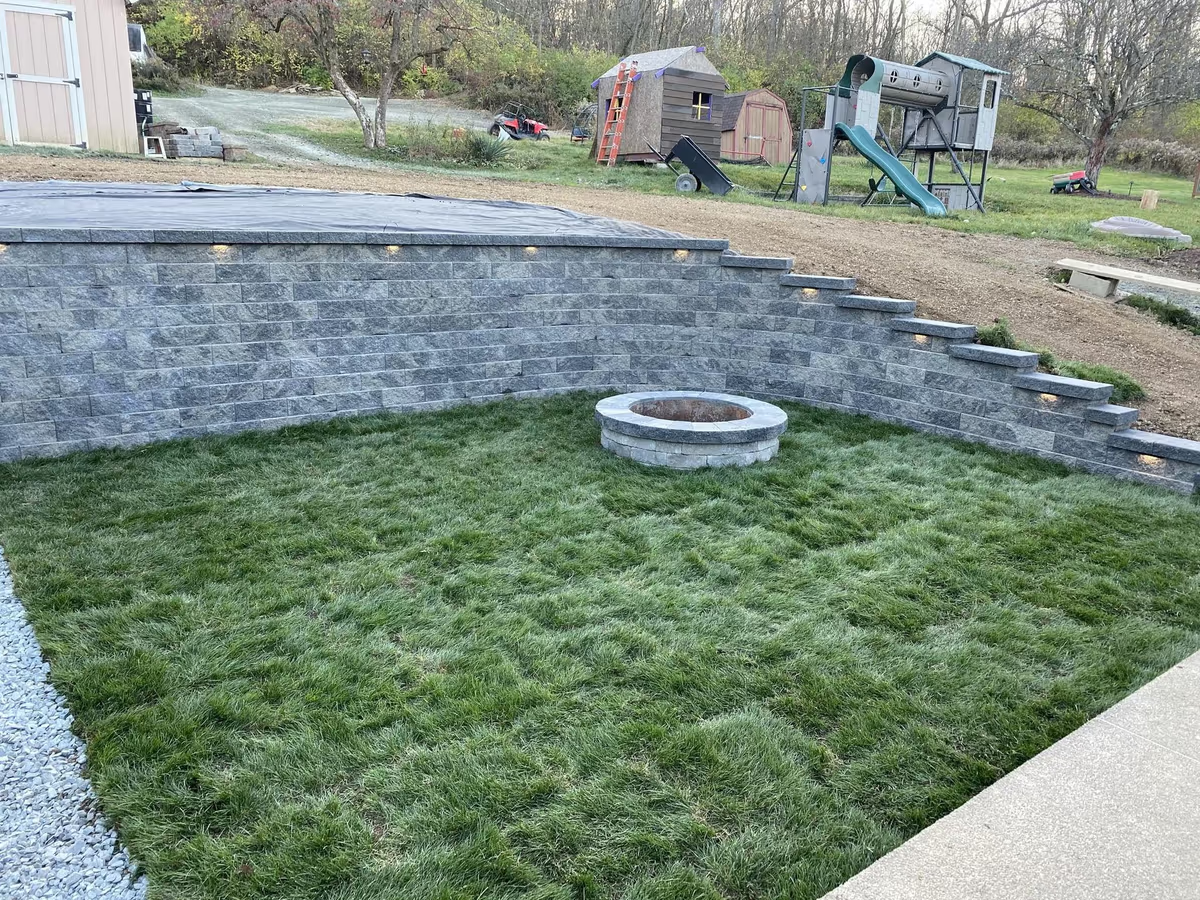
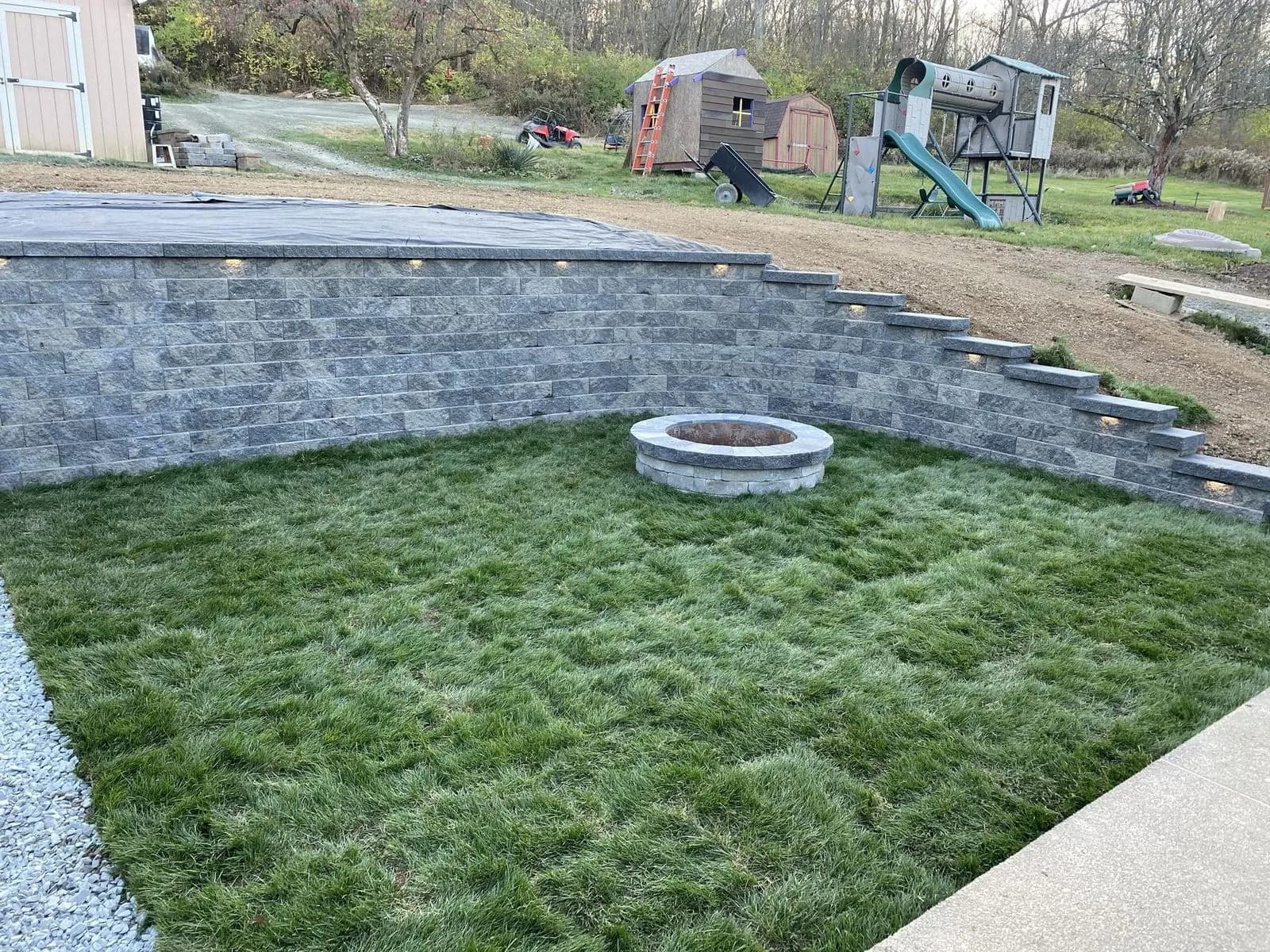
Think of a retaining wall as the foundation that makes the patio possible. It takes the pressure of the slope (all that soil weight pushing laterally) and transfers it straight down into the ground. Once that wall is in place, the area behind it becomes a stable, level platform.
In Pittsburgh, block walls and poured concrete walls are the most common choices for patio-adjacent applications. Both handle the freeze-thaw stress better than timber, which tends to rot and move over time. Boulder walls are also popular on larger grades; they handle equipment-accessible slopes especially well and have a natural look that fits the South Hills terrain.
The wall height and design depend entirely on how much grade needs to be addressed. A two-foot cut on a gentle slope is a different project than a four-foot drop on a steep lot in Jefferson Hills. Both are very doable; they just require different approaches to drainage, footer depth, and wall engineering.
Excavation Comes First
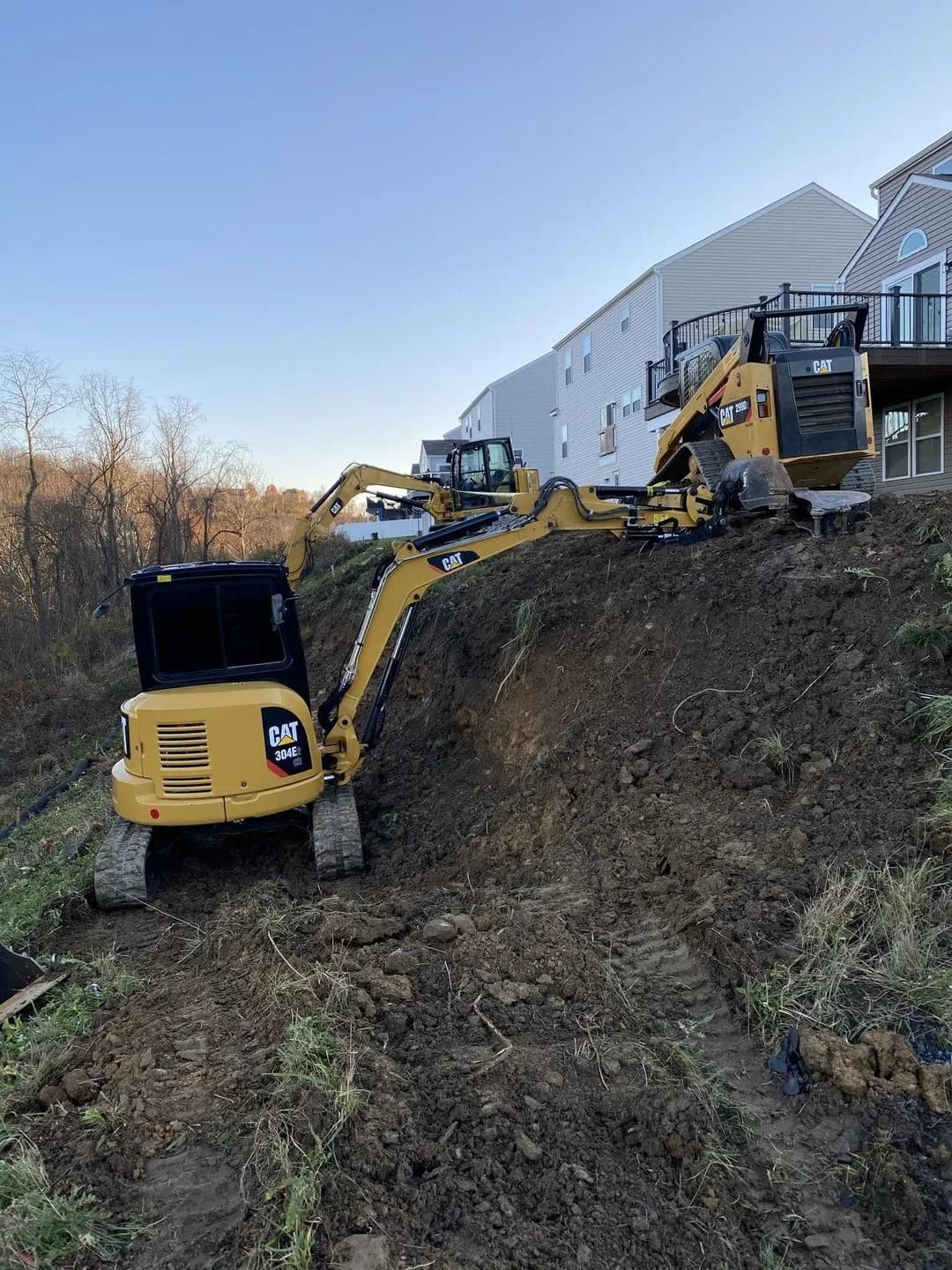
Before the wall and before the patio, there's excavation. The hillside has to be cut back to create the terrace, the spoil has to be removed, and the footer trench for the wall has to be dug below the frost line, about 36 inches in the Pittsburgh area.
This is where equipment matters. A mini excavator can get into most residential backyards, even tight ones in Baldwin or Castle Shannon where access is limited. The cut, the footer work, and the rough grading all happen in the same mobilization, which is one reason it makes sense to do the wall and patio as a combined project rather than phasing them separately.
Two separate mobilizations means two sets of equipment hauls, two rounds of site disruption, and usually more cost overall. When you're already in the yard doing excavation for the wall, the patio prep (gravel base, compaction, form layout) is a natural next step.
Spring Timing in Pittsburgh
April is one of the better times to start this kind of project. The ground has thawed, contractor schedules open up before the summer rush, and concrete poured in moderate spring temperatures cures better than concrete poured in July heat or late-fall cold.
The one caveat in Pittsburgh is soil saturation. Early spring after snowmelt can leave clay-heavy ground wet enough that excavation tracks up the yard and compaction is harder to achieve. A few dry weeks in mid-to-late April usually resolves that. If you're planning a spring project, reaching out early to get on a schedule makes sense: by the time the estimate is done and materials are sourced, the ground is typically ready.
What to Expect From the Project
For a typical Pittsburgh hillside patio with an adjacent retaining wall, here's the general sequence:
1. Excavation: cut the terrace, remove spoil, dig footer trench 2. Wall footer: poured concrete below frost line 3. Wall construction: block, boulder, or poured concrete depending on design 4. Backfill and drainage: gravel backfill behind wall, drainage pipe where needed 5. Patio base prep: gravel base, compaction, forms 6. Concrete pour: flatwork, finishing, curing 7. Final grading: clean up around the new structureMost residential projects of this scope take one to two weeks depending on grade, wall height, and weather. Because the wall and patio are done by the same crew, handoffs are clean and nothing falls through the cracks between contractors.
Ready to Figure Out What Your Yard Needs?
If you've got a sloped backyard in the South Hills and a patio has been on the list, spring is a good time to at least get eyes on it. The scope varies a lot by property: some yards need a modest two-foot wall and a straightforward pour; others are a bigger undertaking. The only way to know is to look at it.
Reach out for a free estimate and we'll come take a look at your grade, talk through options, and put together a quote that covers everything (wall, excavation, and patio) so there are no surprises partway through.