
The Cause Most Pittsburgh Homeowners Don't Expect
Pittsburgh's concrete doesn't just age. It gets worked over every winter. The freeze-thaw cycle is the single biggest cause of concrete damage in Western PA, and it's relentless. Water gets into small surface pores, expands by about 9% when it freezes, and pushes the concrete apart from the inside. Then it thaws, contracts, and the whole cycle repeats dozens of times between November and March.
That expansion pressure is measured in thousands of pounds per square inch. Given enough cycles over enough winters, even well-installed concrete loses.
This is why cracking, spalling, and surface deterioration are nearly universal in Pittsburgh driveways, walkways, and patios after a decade or so. It's not necessarily a sign of bad concrete or poor installation; it's the climate doing what it does.
The Other Factors Working Against Pittsburgh Concrete
Freeze-thaw damage is the headline, but it rarely works alone.
Clay soil movement. Most South Hills properties sit on clay-heavy soil. Clay expands when wet and contracts when dry, meaning the ground beneath your concrete is constantly shifting. Over time, that movement creates voids, uneven support, and differential settling that cracks slabs or pushes edges up. Poor drainage underneath. Water that pools beneath a slab softens the subbase and creates voids when it washes soil away. This is how you end up with a sunken driveway section or a patio slab that flexes when you walk on it. The concrete itself may still be structurally sound, but the ground underneath is gone. Deicing salts. Road salt and sidewalk salt accelerate surface spalling significantly. Salt lowers the freezing point of water, which means more freeze-thaw cycles per winter and more surface damage per cycle. On front walkways and driveways that get salted heavily, spalling often appears before cracking. Age and carbonation. Concrete naturally becomes more brittle over time as it carbonates, a chemical reaction with CO2 in the air that continues for the life of the slab. Older concrete cracks more easily under the same stress a newer pour handles fine.Identifying What You're Dealing With
Before deciding whether to repair or replace, it helps to understand the type of damage you have.
Surface Spalling
Spalling is the flaking, pitting, or chipping of the top layer: the concrete looks like it's peeling apart. It's almost always a surface issue caused by freeze-thaw, salt, or a weak surface in the original pour. The slab is usually structurally fine; the damage is cosmetic and protective layer loss.
Spalling can be repaired with surface patching and resurfacing materials that bond to existing concrete, provided the substrate underneath is still sound.
Hairline and Structural Cracks
Hairline cracks (thin lines under 1/8 inch wide with no vertical displacement) are normal in any concrete. They become a problem when water infiltrates and accelerates freeze-thaw damage over successive winters.
Wider cracks, cracks with vertical displacement where one side sits higher than the other, or cracks that keep growing season to season are a different situation. Those indicate movement in the subbase (heaving, settling, or erosion underneath) that needs to be addressed before any surface repair will hold.
Sunken or Uneven Slabs
When a section of driveway or patio drops, it's usually because soil beneath has eroded, compressed, or shifted. Sunken slabs are tripping hazards and collect water, which accelerates further damage.
In many cases the concrete itself is still intact and can be lifted and releveled. In others, the slab is cracked or crumbling badly enough that replacement is the cleaner path.
Repair vs. Replace: How to Decide
Repair makes sense when:- Damage is isolated to one or two spots rather than widespread across the surface
- Cracks are hairline or minor without displacement
- Spalling is surface-level and the slab passes a soundness check. Tap it with something hard: a solid ring is good; a hollow sound means voids beneath
- Sunken slabs are otherwise intact and the underlying drainage or soil issue is fixable
- More than a third of the surface is cracked, spalled, or structurally compromised
- Cracks are wide, deep, and showing active movement season to season
- The slab has multiple sunken sections from chronic drainage or soil problems
- The concrete is old enough that a repair will likely fail within the next few winters anyway
An honest assessment means looking at what's causing the damage, not just the damage itself. Patching a driveway that has a drainage problem underneath just delays replacement. Fixing the drainage and repairing the surface is worth doing. Patching over an ignored drainage problem is not.
The Pittsburgh Timing Window
Concrete repair has a weather dependency that Pittsburgh makes tricky. Repair materials need temperatures consistently above 50°F to cure properly; below that, the chemistry slows down or fails.
That gives you roughly late April through October in Pittsburgh. Late spring is the ideal window for a few reasons: the full extent of winter damage is visible, temperatures are stable, and you have an entire season before freeze-thaw cycles start testing the repair again.
If you've been watching a crack get wider each spring, acting this season rather than waiting until next year is almost always the right call. Water that's already infiltrating will continue working through summer rains, and then freeze-thaw will accelerate the damage the moment November arrives.
What a Repair Project Actually Looks Like
Minor crack filling is quick, a few hours for a driveway. Surface resurfacing over a larger area typically takes a day and needs 24 to 48 hours before foot traffic. Slab lifting and leveling can often be handled in a single visit.
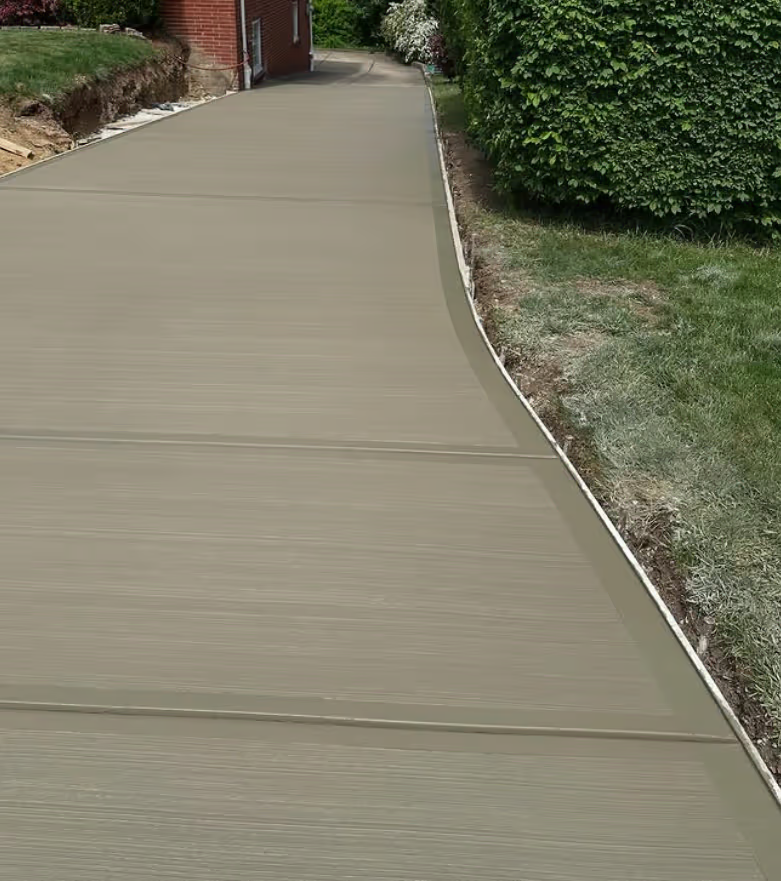
Replacement is a bigger undertaking (demolition, subbase work, forming, pour, and cure time), but it's the right call when a repair simply isn't going to hold. It's also the moment to upgrade the finish: alongside standard broom finishes, we pour stamped and exposed aggregate concrete. The advantage of having the same contractor handle any drainage or excavation work alongside the concrete is that subbase problems get addressed in the same scope. Nothing is worse than discovering a drainage issue after new concrete is already down.
Stop Watching the Damage Get Worse
Dirt Works handles concrete repair throughout Pittsburgh's South Hills: Whitehall, Jefferson Hills, South Park, Peters Township, Baldwin, Bethel Park, Mt. Lebanon, and Castle Shannon.
If your driveway, walkway, or patio has been on the list, reach out for a free estimate and we'll assess what it actually needs (repair, replacement, or both) before another winter adds to the damage.