
When Pittsburgh's Spring Rain Has Nowhere to Go
Pittsburgh gets about 38 inches of rain per year, spread fairly evenly across all four seasons. In spring, that rain hits ground that's been frozen, thawed, and compressed all winter. If your yard has clay-heavy soil (and most South Hills properties do), that water has nowhere to go fast.
The result: standing water in low spots, soggy areas that stay wet for days, water creeping toward your foundation, or muddy paths that never seem to dry out. If this sounds familiar, a French drain might be the solution. But it's worth understanding what it actually does, when it's the right fix, and when something else is needed first.
What a French Drain Actually Is
A French drain isn't complicated. It's a gravel-filled trench with a perforated pipe at the bottom, sloped to carry water away from problem areas to a safe outlet: usually a downhill slope, a storm drain, or a dry well.
Water follows the path of least resistance. When soil is saturated, water moves toward any porous material nearby. A French drain exploits that tendency: water seeps into the gravel, enters the perforated pipe, and flows downhill and away.
The system works underground without pumps or ongoing maintenance beyond keeping the outlet clear. A properly installed drain can last 20 to 30 years.
Signs Your Pittsburgh Yard Might Need One
Water Pools in the Same Spots Every Rain
If you have a low area that consistently holds water after a normal spring shower (not just a major downpour), the soil isn't draining fast enough to keep up. On Pittsburgh's clay-heavy lots, this is extremely common. Clay holds water rather than letting it pass through, and once the ground is saturated, there's no quick relief.
If pooling always happens in the same location, a French drain routed through or around that area can intercept groundwater before it accumulates.
Your Yard Stays Soggy for Days
A yard that's soft and wet for 24 to 48 hours after rain is normal. A yard that's still soggy four or five days later has a drainage problem. This is especially common on shaded north-facing slopes and in low-lying areas where neighboring runoff collects.
Prolonged saturation kills grass roots, creates conditions for fungal lawn disease, and makes the yard unusable for much of spring. A French drain intercepts subsurface water before it saturates the root zone.
Water Is Moving Toward Your Foundation
This is the most urgent sign. If you notice water pooling against your house, damp spots in your basement after rain, or water stains on your foundation walls, you have a drainage problem that needs to be addressed before it causes structural damage.
French drains installed along the foundation perimeter, combined with proper grading, redirect that water away from the house. In Pittsburgh's South Hills, where many homes sit on slopes with uphill neighbors draining toward them, this is one of the most common projects we handle.
Runoff from Uphill Neighbors or Streets
Pittsburgh's terrain means a lot of properties are at the bottom of a slope, receiving water from uphill lots, driveways, or roads. Even if your own yard drains reasonably well, you may be collecting everyone else's water.
A French drain positioned along the uphill edge of your property can intercept that surface and subsurface flow before it reaches your home or lower yard areas.
When a French Drain Isn't the Right Fix
A French drain works when the problem is water moving through or accumulating in soil. It won't solve every drainage issue:
- If your yard sits low relative to the street or neighbors, regrading may need to come before or alongside a drain. Water that can't reach an outlet will back up regardless.
- If your downspouts are dumping water against the foundation, that's a grading and downspout extension issue, not necessarily a drain issue.
- If water is entering your basement through cracks, that's waterproofing work, not surface drainage.
A good contractor will look at the full picture before recommending a French drain. If the outlet doesn't work, neither will the drain.
What French Drain Installation Looks Like
The process isn't particularly disruptive, but it does require excavation, which is why it's not a reliable DIY project.
A typical residential installation involves:
- Staking the drain path and confirming the outlet location and grade
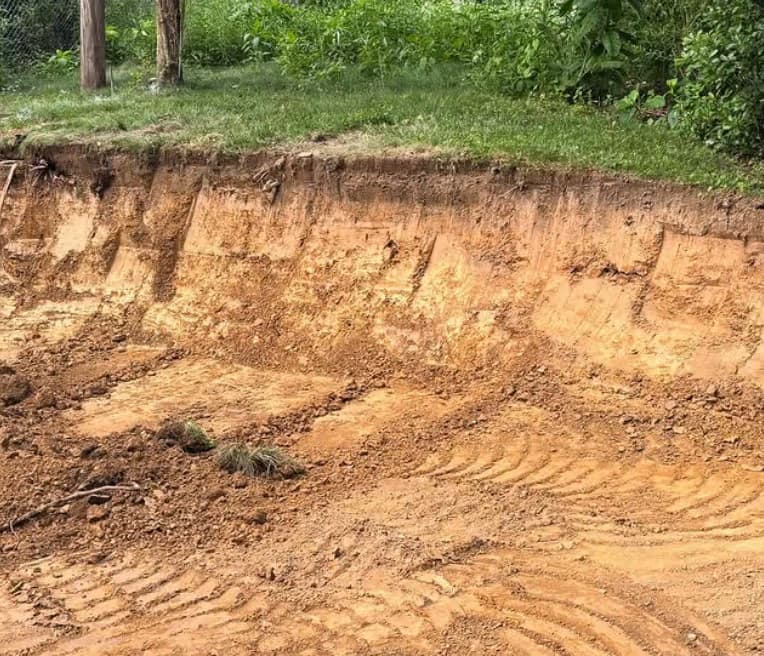
- Excavating a trench, usually 12 to 24 inches deep and 12 inches wide, sloped toward the outlet
- Lining the trench with landscape fabric to prevent soil infiltration over time
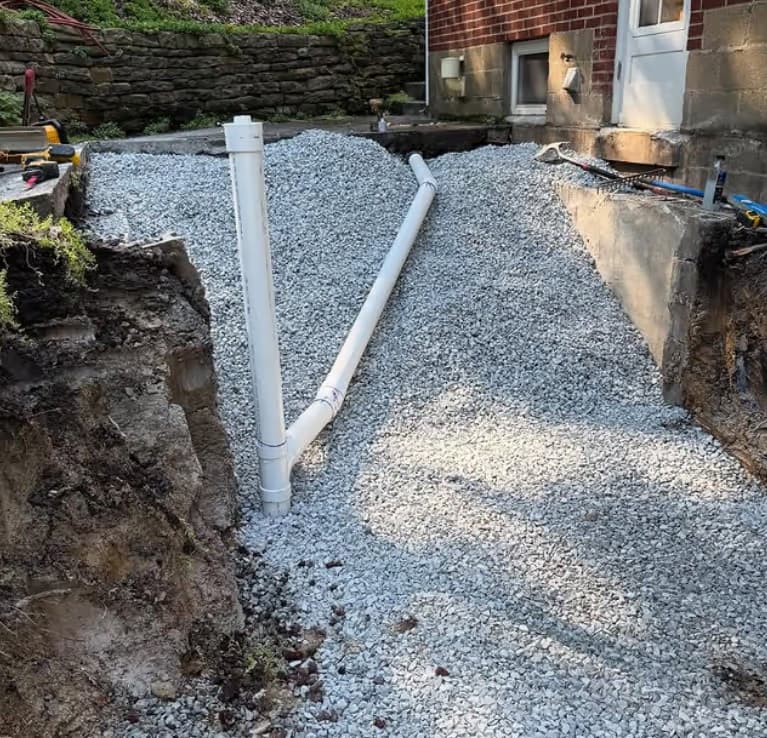
- Laying gravel, then the perforated pipe, then more gravel on top
- Wrapping the fabric over the top and backfilling to grade
The outlet typically daylights on a slope, connects to an existing storm drain, or feeds a dry well. For a typical South Hills yard, the whole process takes one to two days.
After installation, the surface above the trench is restored: topsoil and seed, sod, or gravel, depending on location and visibility.
French Drain Costs in Pittsburgh
For a standard residential French drain (50 to 100 linear feet, daylight outlet, straightforward access), expect to pay somewhere in the $2,500 to $5,500 range in the Pittsburgh area. Longer runs, difficult access, rock or root obstacles, and dry well installation push costs higher.
The cost of not addressing the drainage problem (foundation repairs, repeated basement water intrusion, or lawn damage year after year) typically far exceeds the drain installation.
Is Now a Good Time to Install One?
Late spring is one of the better windows for French drain installation. The ground is fully thawed and workable, you can see exactly where the water problems are occurring while they're still active, and a newly seeded surface above the trench has a good window to establish before summer heat sets in.
If you've been watching the same wet spots appear every spring, this season is a reasonable time to act rather than waiting another year.
Ready to Stop Watching the Water Pool?
Dirt Works handles French drain installation, yard regrading, and drainage excavation throughout Pittsburgh's South Hills, including Whitehall, Jefferson Hills, South Park, Peters Township, Baldwin, Bethel Park, Mt. Lebanon, and Castle Shannon.
If you're seeing standing water, a soggy yard, or water near your foundation, we can take a look and give you a straightforward estimate. Contact us for a free assessment.